




PsychLaw Experts Handle
Matters of Parental Alienation
Parental alienation refers any constellation of parental behaviors, whether intentional or unintentional, that are commonly associated with undermining or damaging a child’s relationship the other parent (Baker & Darnall, 2006, p. 98). Some of the most common behaviors employed in parental alienation are:
Bad mouthing (Baker & Darnall, 2006)
Telling the child the target parent does not really love them (Baker & Darnall, 2006)
Communicating to the child the target parent is dangerous they are not (Baker & Darnall, 2006)
Limiting contact with target parent for non-protective reasons (Baker & Darnall, 2006)
Belittling the target parent in front of the child (Baker & Darnall, 2006)
Inducing conflict between the child and the target parent (Baker & Darnall, 2006)
Confiding in the child about the marital relationship (Baker & Darnall, 2006)
Forcing the child to reject the target parent (Baker & Darnall, 2006)
Forcing the child to choose between his/her parents (Baker & Darnall, 2006)
Withdrawing love & getting angry if the child shows positive feelings for the target parent (Baker & Darnall, 2006)
Making repeated, unfounded allegations of child abuse (Saini et al., 2020)
Exaggerating the target’s negative behavior (Warshak, 2010)
Telling lies about the target parent (Warshak, 2010)
Revising the history of the child’s relationship with the target parent to erase positive memories of the target parent (Warshak, 2010)
Associating the label ‘the truth’ with the programmers implanted scenarios (Warshak, 2010)
Instructing children to keep secrets from, spy on, and lie to the target parent (Warshak, 2010)
Programming the child to resist attempts to undo their indoctrination (Warshak, 2010)
Inducing a loyalty conflict (Bernet & Lorandos, 2023)
Some children who are exposed to parental alienation will go on to exhibit symptoms of parental alienation syndrome. Parental alienation (PA) and parental alienation syndrome (PAS) refer to two different phenomena. Whereas parental alienation refers to parental behaviors that could cause harm to the child’s relationship with the other parent (Darnall, 2008), parental alienation syndrome refers to a cluster of eight symptoms that may or may or may not appear in a child after the child has been exposed to parental alienation (Baker & Darnall, 2007; Gardner, 2006). The eight symptoms of PAS are as follows:
Campaign of denigration
Frivolous, absurd, or irrational rationalizations for the denigration
Lack of ambivalence
Borrowed scenarios
Reflexive support for the alienating parent when the parents are in conflict
Independent thinker phenomenon
Absence of guilt for mistreatment of the target parent
Spread of animosity
Some researchers after Dr. Gardner’s passing in May of 2003 believe that the term ‘Parental Alienation’ should refer to both PA and PAS as noted by Bernet (2020) when he wrote: “Parental alienation is a mental condition in which a child allies strongly with one parent and rejects a relationship with the other parent without legitimate justification.” However, conflating PA with PAS in this way creates two false assumptions:
Symptoms of PAS must be present to diagnose parental alienation
The alienated child must be resisting, refusing, avoiding, or rejecting a relationship with the other parent (Wygant, 2024, Wygant, 2025a, Wygant, 2025b)
The reason why these assumptions are false is that not all children exposed to parental alienation will develop symptoms of the syndrome or resist, avoid, or refuse contact. Yet, we still diagnose parental alienation whenever children are exposed to behaviors that are likely to cause the symptoms of PAS regardless of whether any symptoms ever appear. This is how all child psychological abuse is assessed and diagnosed.
It is important to understand that the conflation of parental alienation with parental alienation syndrome refers to “the error of treating two distinct concepts as if they are one” (Moore, 2007). Gardner (2002) warned that “to call parental alienation syndrome parental alienation cannot but produce confusion.” His primary concern was that such conflation would result in false negative findings in cases where a child had been exposed to parental alienation child abuse but had not yet developed the symptomatic profile of PAS (Wygant, 2024).
Shawn Wygant’s Parental Alienation Child Abuse Model (PACAM) that was officially introduced at the October 2024 Parental Alienation Consortium Legislative Summit addresses this problem directly by disentangling PAS from PA and re-aligning both constructs with their distinct phenomenological and diagnostic origins. PACAM recognizes that diagnosing PA as a form of psychological maltreatment is based on a child’s exposure to parental behaviors “that have reasonable potential to result in significant psychological harm to the child” regardless if harm results (American Psychiatric Association, 2013, p. 719).
Shawn’s approach aligns with the empirical scientific understanding that psychological maltreatment should be identified and reported based on a child’s exposure to acts of maltreatment (PA), rather than waiting for observable indicators of harm (PAS) to emerge (Hart et al., 2022). For example, if a parent repeatedly teaches a child to steal groceries by placing unpaid items into the child’s backpack during shopping trips, we do not wait for the child to develop a pattern of kleptomania before recognizing the parent’s behavior as corrupting/exploiting psychological maltreatment.
The same principle applies to parental alienation: if a child is being programmed and brainwashed by an alienating parent to develop an unwarranted hatred toward a non-abusive, loving target parent, intervention should not wait until the child begins to exhibit symptoms of PAS. Instead, the presence of acts of maltreatment (PA) itself warrants a child protective response. This is explicated in slide 23 from Shawn’s March 22, 2025 PACAM presentation at the American College of Forensic Psychology 40th Annual Symposium: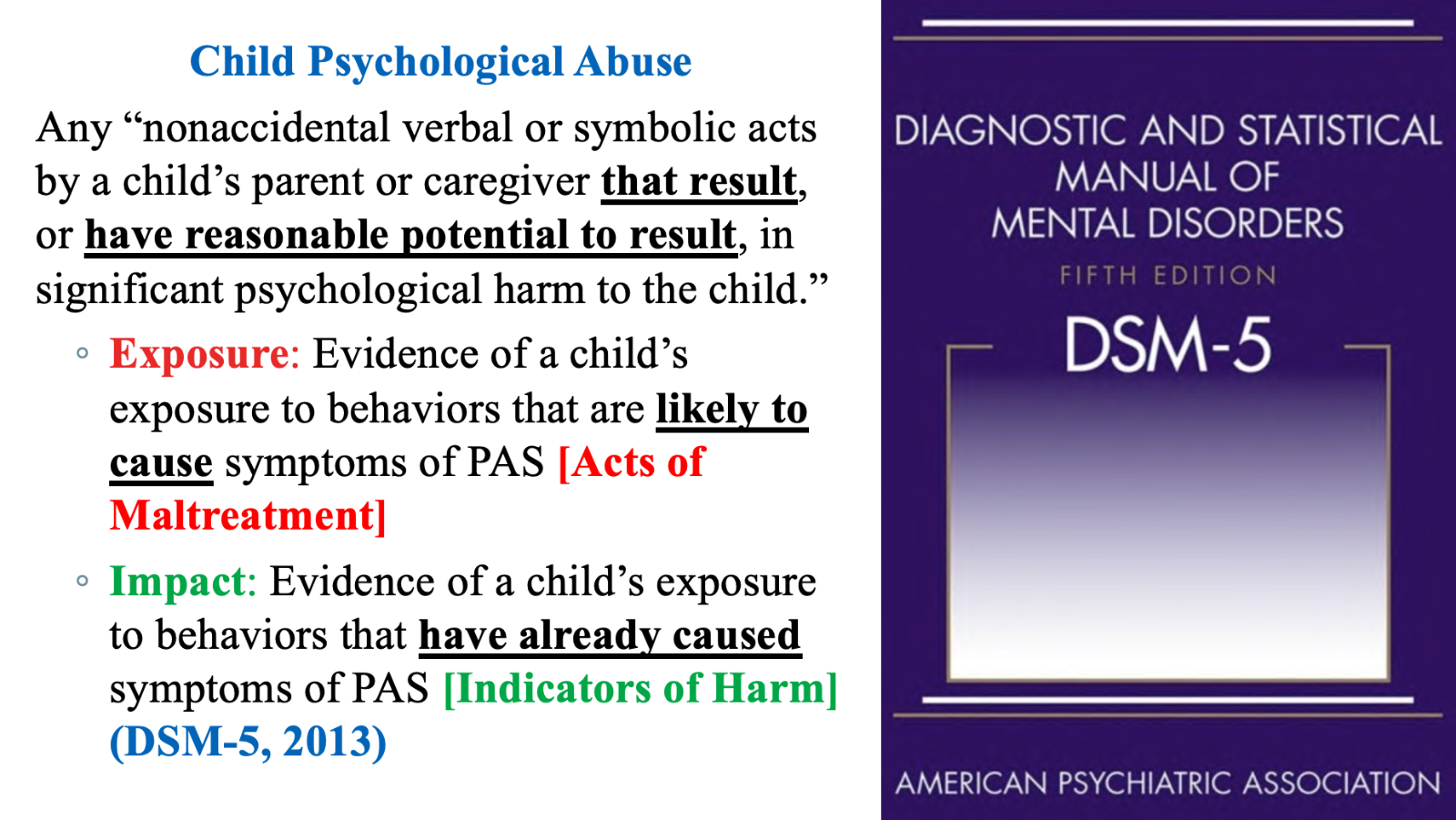
© Shawn Wygant, — All Rights Reserved Parental Alienation Child Abuse Model | PsychLaw | 2024-2025
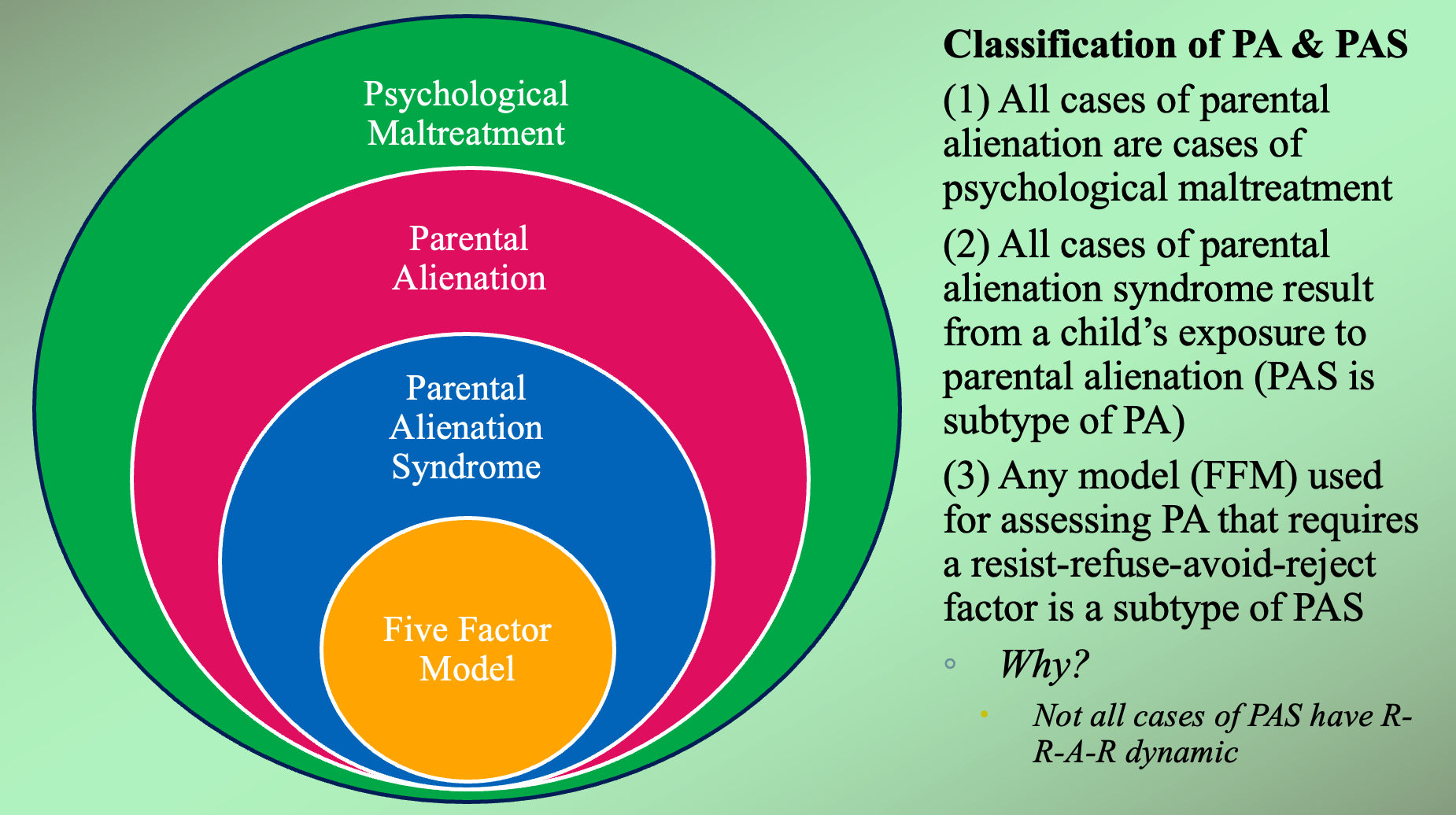
Any model of parental alienation that requires indicators of harm or necessitates that the child be avoiding or resisting contact—such as the Five-Factor Model (FFM; Bernet & Greenhill, 2022), Resist-Refuse Dynamics (RRD; Garber, 2020), or Parent-Child Contact Problems (PCCP; Sullivan et al., 2023)—fails to identify cases of parental alienation in the early stages of the abuse cycle, when intervention is most likely to be effective. Why is this important? Because children are being psychologically abused when they are exposed to parental alienation child abuse, regardless of whether they are exhibiting symptoms of parental alienation syndrome.
It is important to emphasize that a diagnosis of PA or PAS does not require the child to be resisting, avoiding, refusing, or rejecting contact with the targeted parent (Gardner, 1998; Wygant, 2024). The resist-avoid-refuse-reject dynamic is absent in many cases of parental alienation child abuse, and if the scientific community continues to assert that PA or PAS cannot be identified until a child resists contact, a significant number of children exposed to parental alienation child abuse will go unrecognized and unprotected (See McMurphy v. Paz, 2024; Wright v. Wright, 2021). The following chart, originally presented October 5, 2024 at the Parental Alienation Consortium Legislative Summit by Shawn Wygant illustrates the correct classification of PA and PAS:
 © Shawn Wygant, — All Rights Reserved Parental Alienation Child Abuse Model | PsychLaw | 2024-2025
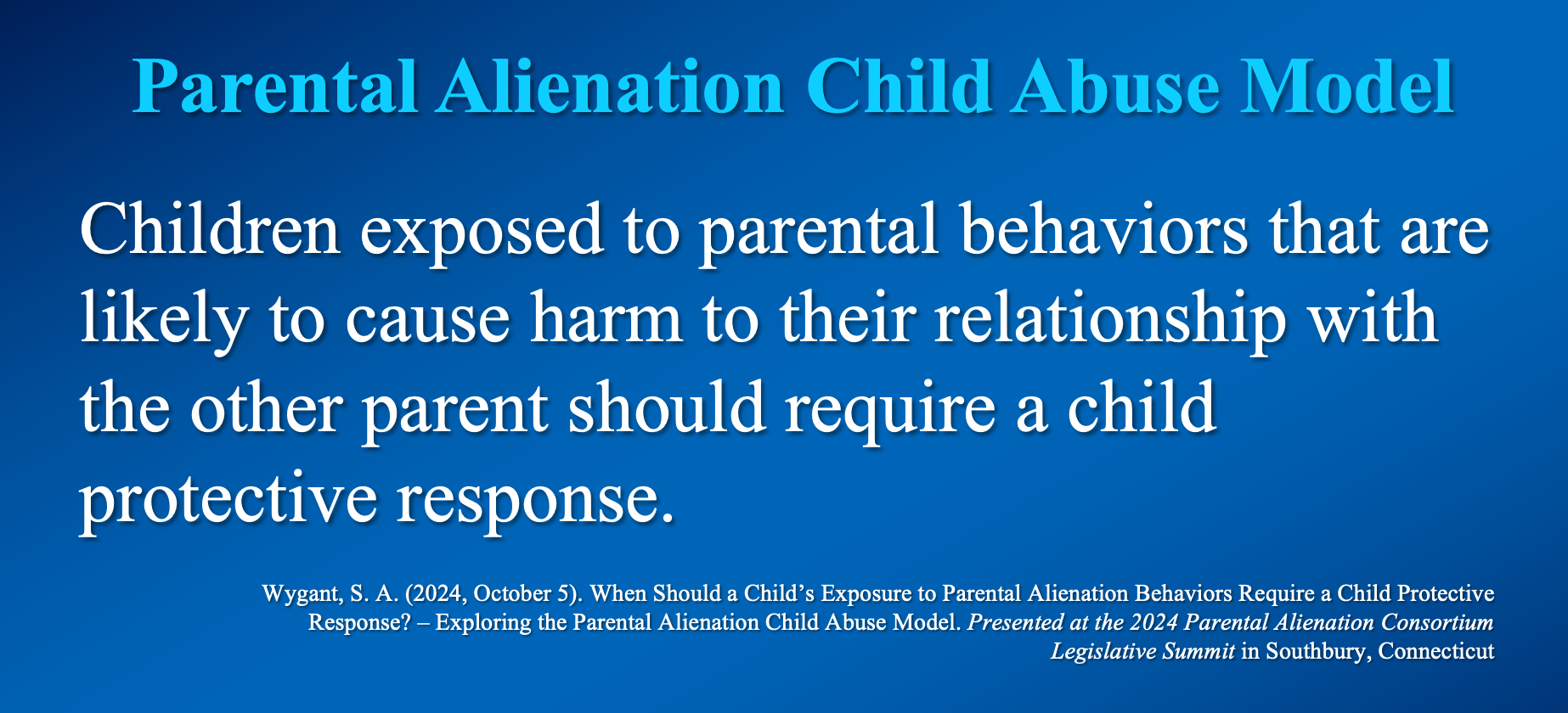
Understanding the correct classification of parental alienation and parental alienation syndrome within the gambit of psychological maltreatment should lead to better efforts at early intervention in cases of parental alienation child abuse as noted by Mr. Wygant in his final slide from his PACAM presentation on October 5, 2024:
© Shawn Wygant, — All Rights Reserved Parental Alienation Child Abuse Model | PsychLaw | 2024-2025
PsychLaw remains firmly committed to stopping parental alienation child abuse whenever it appears in family law cases. Feel free to browse our website using the links below to explore more of the science and law concerning parental alienation and parental alienation syndrome.
Here are the Answers to Your Questions
What are Some of the Warning Signs of Parental Alienation?
What is the Difference between Parental Alienation Syndrome and Parental Alienation?
Parental Alienation Develops Over Time
Why You Should Be Concerned About Parental Alienation
Are There Different Degrees of Parental Alienation?
Criteria for the Diagnosis of Parental Alienation
Brainwashing? Syndrome? Unreasonable Estrangement?
Brainwashing Techniques Used by Alienating Parents
How Can Parental Alienation Be Defeated?
How to Effectively Deal with a Parental Alienation Case
The History of Parental Alienation in the Courts
Basic Research into Parent/Child Alienation
What is the Phenomena of Parental Alienation?
What is the Incidence and Prevalence of Parental Alienation?
What are the Symptoms and Consequences of Parental Alienation?
What are the Strategies used by Alienating Parents?
What Role Should Mental Health Professionals Play in Parental Alienation?
Therapy in Cases of Parental Alienation
Role of the Attorney in Parental Alienation Cases
What Court Action is Warranted in Parental Alienation?
Protecting the Innocent
Are you concerned that your child is being harmed at the hands of the other parent and needs to be protected?
How do you address the fact that your ex-spouse or ex-partner has manipulated your child into unwarranted feelings of estrangement?
How can you prove that the outrageous, exaggerated, or false allegations your divorcing spouse has made against you are absolutely untrue?
Assisting Attorneys — Helping Parents
Whether you are an attorney seeking more information from a legal and psychological perspective or you need cross examining guidance with regard to expert behavioral witnesses, or you are a parent who wants your child back safe and sound, we are the team to call.
We have built a reputation on meticulous preparation, insightful, creative case strategizing, painstaking attention to detail, and thorough investigation.
We do this with the goal of helping our clients, point by point, case by case.
